

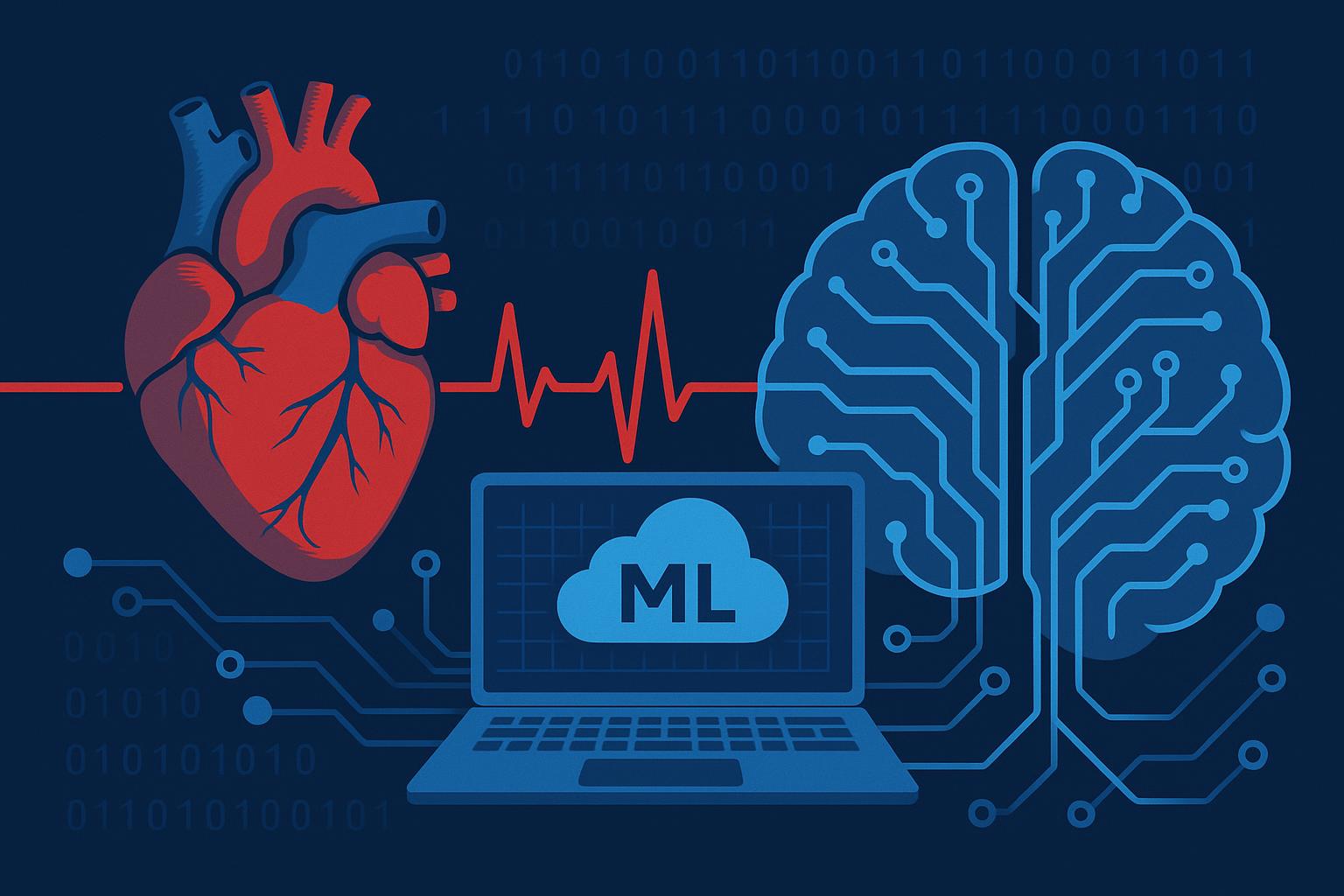
Sanjiv Narayan is a cardiologist, researcher, and professor of medicine at Stanford University whose work spans electrophysiology, arrhythmia care, and digital health innovation. As director of electrophysiology research and the atrial fibrillation program at Stanford, he helps lead efforts focused on developing bioengineering solutions for complex cardiac conditions. With more than two decades of experience in cardiovascular medicine, Dr. Narayan has held leadership roles at Stanford University, the Veterans Affairs Medical Center in San Diego, UC San Diego, and UCLA. His background includes training in medicine, neuroscience, computational neuroscience, and neural network software engineering. Given his longstanding interest in digital health and advanced medical technologies, his professional experience provides relevant context for examining how machine learning is influencing cardiology and shaping new approaches to cardiovascular diagnosis and care.
A Look at Machine Learning in Cardiology Machine learning (AI) is an artificial intelligence (AI) subset where algorithms learn patterns from data to make accurate predictions on new data. ML is today transforming cardiovascular medicine by enabling computers to process vast amounts of medical data, thereby replicating human pattern recognition (1).
Computers extract insights from massive datasets stored in specialized archives. This evolution is a shift in healthcare toward automated diagnostics. The US Food and Drug Administration (FDA) has cleared various algorithms to assist physicians in interpreting radiographs and identifying complex heart conditions earlier.
ML frameworks in cardiology include supervised learning, unsupervised learning, and deep learning. Supervised learning uses labeled elements to teach computers to recognize known conditions, like arrhythmias. In contrast, unsupervised learning analyzes unlabeled data to discover hidden patterns or new disease subtypes.
Deep learning uses artificial neurons to find complex patterns automatically. Therefore, while basic ML requires humans to define specific data characteristics, deep learning models learn directly from raw medical information.
ML has several practical cardiological applications (2). In cardiovascular imaging, algorithms automate echocardiography and magnetic resonance imaging (MRI) calculations. These tools detect subtle blockages or tissue abnormalities that doctors might miss. Deep learning models help identify congenital heart diseases from fetal images and can tell apart different heart muscle thickening types.
Aside from imaging, integrating AI with electronic health helps detect conditions like heart failure early. AI systems predict rehospitalization risk within 30 days more accurately than traditional statistical methods. Wearable technology also aids in monitoring heart health.
Additionally, digital stethoscopes help primary care doctors detect valve disease in about 15 seconds. These tools allow healthcare professionals to manage data-heavy tasks with enhanced speed. Computers triage urgent cases like acute strokes by reviewing scans immediately, allowing physicians to focus on patient care and other clinical interventions.
Among the benefits, integrating ML with cardiology moves the field toward precision medicine, where care becomes tailored to individuals’ specific biological profiles. AI-powered tools act as a reliable second pair of eyes, reducing cognitive overload for busy medical staff. Furthermore, these technologies identify issues such as weak heart pumps with 93 percent accuracy.
ML’s enhanced performance allows professionals to intervene before physical symptoms appear. Consequently, patients receive timely treatment. Clinicians also spend less time on repetitive manual tasks. Overall, these systems significantly improve patient outcomes.
Despite these benefits, there are some challenges. For example, advanced ML models’ logic for certain predictions may be hidden. This lack of explanation makes it difficult for doctors to fully trust automated results. Additionally, ML algorithms may exhibit systemic biases from the data used to train them. Moreover, some models might underestimate mortality risks for specific demographics if the training groups were not diverse (1).
To mitigate these hurdles, regulatory bodies employ a risk-based classification system for medical devices and their software. This oversight ensures that tools undergo rigorous testing before going into the market.
Going forward, there may be a shift toward integrated systems that provide precision medicine at the point of care. Experts predict smart clinics that will use pocket-sized ultrasound devices to introduce advanced diagnostics to underserved regions (3).
Researchers are also developing digital twins, which are virtual heart models used for surgical planning. These simulations allow surgeons to test complex procedures before actual surgeries begin. Lastly, in the future, large language models may synthesize physiological signals with medical data, providing real-time insights that will improve decision-making.
About Sanjiv Narayan
Sanjiv Narayan, MD, PhD, is a professor of medicine at Stanford University and director of electrophysiology research and the atrial fibrillation program. His work focuses on arrhythmia medicine, bioengineering approaches to cardiac care, and advances in digital health. Educated in the United Kingdom and the United States, he has held academic and clinical leadership positions at Stanford, UC San Diego, UCLA, and the Veterans Affairs Medical Center in San Diego. He is a fellow of the American Heart Association and the American College of Cardiology.