

Ricky Sayegh MD is a board-certified physician based in Bergen County, New Jersey, who has built a career around interventional pain management, emergency critical care, and internal medicine. He previously served as chief medical officer for Con Edison, where he delivered vein treatments and back and neck injections as part of an employee wellness initiative. Dr. Sayegh earned his medical degree in 2000 and trained at New York University and Mount Sinai Medical Center, eventually becoming chief medical resident, before completing a physician executive MBA at the University of Tennessee, Knoxville, with an emphasis on health care management, finance, and informatics. He remains engaged with organizations including the American College of Hospital Executives and the American College of Healthcare Fraud Examiners. Away from medicine, he enjoys travel, hiking, and kayaking, a pastime that connects directly to the discussion of river difficulty ratings that follows.
Understanding River Difficulty While Kayaking
Kayaking is a great way to spend more time outdoors and maintain healthy levels of physical activity. It is a low-impact exercise that increases core and upper-body strength and improves cardiovascular function. Other health benefits of kayaking range from weight loss to reduced stress.
While individuals interested in getting more active and spending more time outdoors should strongly consider kayaking, they should also learn about the various challenges and make a plan for gradually increasing the types of rivers, channels, and waterways they attempt to navigate.
In the US, kayakers adhere to American Whitewater’s International Scale of River Difficulty. The scale provides individuals with a basic idea of the challenges they will face and the skills they need to complete a successful passage.
That said, the scale is not exact. A river’s rating might change over time or each day due to various factors and individual kayakers may struggle with certain skills necessary to navigate a certain river or section of rapids.
Furthermore, not every waterway adheres to the American Whitewater scale; for instance, the Grand Canyon uses a unique, 10-point rating system to grade rivers.
Kayakers should avoid going in the water during extreme weather conditions, including excessively cold water temperatures, especially on remote, inaccessible rivers.
When kayaking in a new region for the first time, individuals should conduct extensive research and familiarize themselves with common challenges and features in the area.
Lastly, kayakers must always remain alert: even a low-level river can become dangerous if individuals are not fully prepared.
The International Scale of River Difficulty begins at Class I and escalates to Class VI. At Class I, kayakers can expect a relatively low-level challenge with little to no consequences for an error. These channels are defined by smooth stretches of water with gentle currents, potentially with minor ruffles.
Class I rivers are mostly characterized by clear passages and no downhill sections, but may feature a few gradual curves. These channels do not feature hazards that require any maneuvering from kayakers and are a great place for newcomers to begin.
Class II rivers are similar to Class I, but they sometimes require a bit more skill. Class II channels have slight currents and minor gradient loss, as well as small rapids and regular, small waves. They consist of common hazards, such as rocks, but provide kayakers with obvious passages that involve minimal maneuvering.
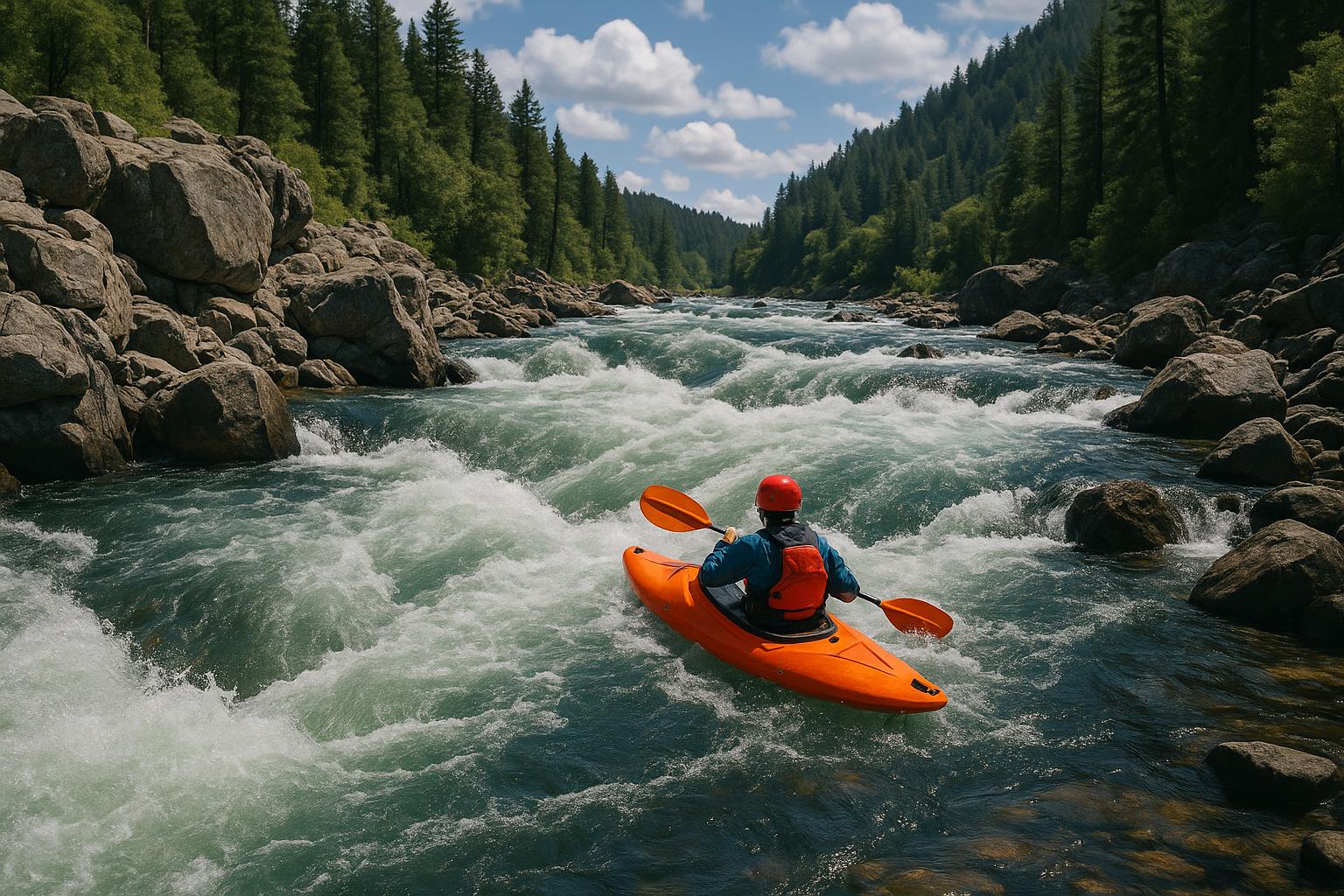
At Class III, kayakers need to prepare themselves for potential consequences after making an error. The water is fast and filled with rocks, eddies, and other hazards, with moderate downhill sections. Kayakers can still take advantage of clear passages between hazards on these intermediate waterways, but they can be narrow and require skilled maneuvering.
Kayakers should avoid attempting Class IV rivers until they have developed advanced skills and performed extensive scouting before a trip. These are highly challenging rivers, and mistakes can lead to serious consequences. Long, powerful rapids push kayakers into uniquely challenging hazards, such as boiling eddies and recirculating hydraulics, along with steep downhill sections.
Without the ability to execute precise maneuvers, kayakers can run into serious problems on Class IV waterways.
Finally, Class V rivers are for experts, and only after comprehensive planning. The International Scale of River Difficulty also recognizes Class VI rivers, which may be described as impossible to navigate under certain conditions. Unavoidable hazards can lead to extreme consequences for kayakers.
About Ricky Sayegh MD
Ricky Sayegh, MD, is a board-certified physician in Bergen County, New Jersey, whose practice centers on interventional pain management alongside emergency critical care and internal medicine. He previously served as chief medical officer for Con Edison, focusing on employee wellness through vein treatments and back and neck injections. Dr. Sayegh completed his residency at New York University and Mount Sinai Medical Center and later earned a physician executive MBA from the University of Tennessee, Knoxville. He is active with the American College of Hospital Executives and the American College of Healthcare Fraud Examiners.