


Thomas Guglielmo is a New York–based professional whose background spans accounting, operations, and athletics. Currently a cost accountant with Magellan Aerospace, Thomas Guglielmo supports accounting accuracy and quality across global manufacturing operations while pursuing an accounting degree at Kean University in New Jersey. His professional experience includes roles in inventory control and distribution supervision, where he applied Six Sigma principles to improve efficiency and production outcomes across multiple product lines.
Beyond his work in finance and operations, Thomas Guglielmo has a long-standing personal and leadership connection to skiing. An avid skier, he served as head freestyle ski coach at Hunter Mountain in New York from 2010 to 2016, guiding athletes through technical development and safety-focused training. His combined experience in disciplined professional environments and freestyle skiing provides a practical perspective on how the sport balances creativity, structure, and risk management.
An Introduction to Freestyle Skiing
The 2024-2025 ski season was the second busiest in America’s history, with resorts and mountains recording 61.5 million visits. While many skiers in the United States enjoy downhill skiing, or alpine skiing, the sport offers numerous unique disciplines to choose from, including freestyle skiing.
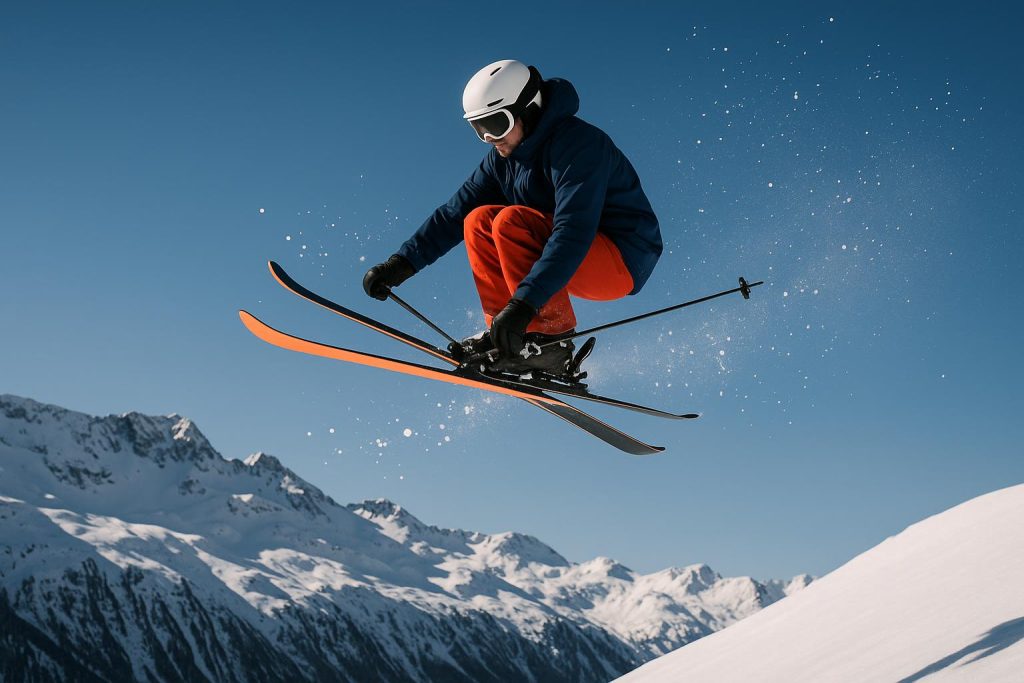
Freestyle skiing is a unique sport that allows athletes to demonstrate their creativity, acrobatic flair, and technical ability over a series of high-risk tricks and maneuvers. Skiers can further specialize in one or more of several freestyle disciplines, including moguls, aerials, half pipe, ski cross, slopestyle, and big air.
The moguls discipline requires skiers to descend a steep slope characterized by shallow grooves and small mounds. These features, called moguls, place considerable strain on the athletes’ legs. In addition to the moguls, courses feature two jumps.
Aerials, arguably the most high-risk freestyle discipline, involves athletes catching big air off a steep ramp and performing various twists and flips before touching down on a steep, inclined slope. Slopestyle and halfpipe, meanwhile, are comparable to skateboarding events and consist of several terrain features, including jumps, boxes, rails, and the halfpipe.
The sport of freestyle has its origins in the early 20th century, but it did not begin to resemble its modern form until the 1960s and 1970s, when daring athletes decided to integrate unique, high-flying maneuvers into their downhill runs. Athletes and audiences alike enjoyed the creative expression and bravado of early freestyle skiing, allowing the discipline to flourish.
The International Ski Federation officially recognized freestyle as a discipline in 1979. As part of this move, the organization established judging regulations for competition, as well as safety standards. When participating in freestyle skiing, individuals should adhere to the National Ski Areas Association Responsibility Code, which describes foundational safety criteria, including how to manage right-of-way. Freestyle skiers must follow additional safety tips, such as investing in high-quality protective gear, ranging from durable helmets and goggles to waterproof clothing that does not restrict a skier’s range of movement.
Freestyle skiers must also use specialized equipment. Options include mogul skis, which are shorter than standard skis, allowing athletes to make sharper turns, and skis for halfpipe and slopestyle, which bend up at the ends, providing skiers with added lift as they come off the tip of terrain features.
With safety and competition standards in place, it did not take long for freestyle skiing to reach the world stage. The freestyle discipline made its Olympic debut at the 1988 Winter Games in Calgary as a demonstration event, then officially joined the Olympic program at the 1992 Winter Olympics in Albertville. France’s Edgar Grospiron earned a gold medal in moguls, while Donna Weinbrecht of the United States won the women’s competition.
The freestyle program continued to grow in popularity and participation. Aerials debuted at the Olympics in Lillehammer in 1994, followed by ski cross at the Turin 2006 Games, and finally halfpipe and slopestyle rounded out the competitions at the Sochi Olympics in 2014. In addition to the Olympics, freestyle athletes compete at the International Ski and Snowboard Federation, the Winter X Games, and many more major events around the world.
About Thomas Guglielmo
Thomas Guglielmo is a cost accountant with Magellan Aerospace and an accounting student at Kean University. He has professional experience in inventory control, distribution operations, and process improvement using Six Sigma principles. Outside of his accounting career, he is an avid skier and former head freestyle ski coach at Hunter Mountain, where he coached from 2010 to 2016.

