


Joel Bartsch has devoted decades to museum leadership and science education through his work with the Houston Museum of Natural Science. A graduate of Concordia University and Rice University, he has served in multiple museum leadership roles, including curator, director, and ultimately president and CEO of HMNS. During his tenure, he helped expand the museum’s exhibits, educational programs, and international collaborations. His experience working with natural science collections and exhibits provides valuable context for topics such as John James Audubon’s Birds of America. Through exhibitions that explored Audubon’s ornithological work and the controversies surrounding some discoveries, HMNS introduced visitors to several bird species first described by the renowned artist, naturalist, and explorer.
A Few of Audubon’s Notable Bird Discoveries
Established in 1909, the Houston Museum of Natural Science (HMNS) operates with the belief that science can improve the lives of every American. During more than a century of service in the Houston area, the nonprofit organization has provided local patrons and visitors from around the world with access to an array of permanent galleries and visiting exhibits, including Audubon’s Birds of America, a collection of ornithological prints from John James Audubon. Audubon originally published his collection in several volumes between 1827 and 1838. Several of his hand-colored, life-size prints depict birds that had never previously been described.
Throughout his career as an artist, naturalist, and explorer, John James Audubon discovered or described for the first time more than 20 bird species, though he made several of these discoveries while collaborating with colleagues such as John Kirk Townsend. To begin, the International Ornithological Congress lists Audubon as the primary author of the Common Poorwill. These nocturnal birds feed off insects and, as the Western nights grow long and cold, enter a state of torpor that allows the Common Poorwill to survive until food scarcity improves.
Audubon was also the first ornithologist to describe the King Rail. The King Rail is a large marsh bird that somewhat resembles a chicken, sized roughly between a robin and a crow. Because Audubon was committed to rendering his bird prints to scale, he had to draw larger specimens like the King Rail in oddly contorted positions so that they fit on the page. Bird-watchers can identify the King Rail by its plump belly, long neck, and short tail. These well-camouflaged birds have blackish brown and olive-gold color patterns, with rusty reddish wings.
The Black Oystercatcher is one of numerous bird species identified by Audubon in 1838. As the name suggests, the bird is covered in black feathers, with the exception of a distinctly reddish orange beak and vibrant yellow eyes. One of several species in the American Oystercatcher family of birds, it ranks among the larger birds in Audubon’s Birds of America collection.
Audubon also described the Snowy-Crowned Tern in 1838. Modern ornithologists associate the bird with the Atlantic coasts of Argentina and Chile, despite Audubon describing the species as native to Cape May, New Jersey. This is one of numerous controversies surrounding Audubon’s discoveries, which HMNS did not shy away from exploring in its Birds of America exhibit.
The following year, Audubon became the primary author of the Western Gull. One of the most common seabirds in the United States, the Western Gull is especially numerous along the Pacific Coast. Birders can distinguish the Western Gull from similar species by its large size and distinctly dark back. Despite the bird’s prominence, numbers have declined in recent years, earning the Western Gull a place on the Partners in Flight Yellow Watch List.
The Black-Footed Albatross is another large bird in the Birds of America collection. First described by Audubon in 1839, it is one of three albatross species regularly viewed in the Northern Hemisphere, typically around the West Coast of North America. However, bird enthusiasts must schedule offshore expeditions from places like Half Moon Bay, California, to catch a glimpse of these birds gliding and feeding over the Pacific Ocean.
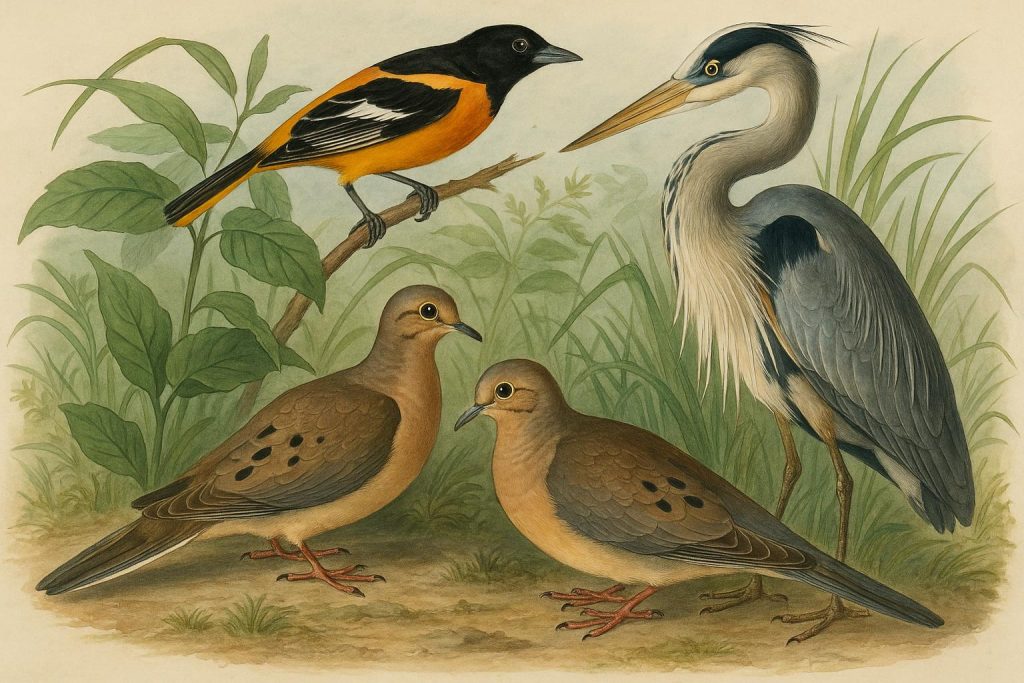
These are only a few of the species Audubon first described in his multivolume Birds of America. He also described many subspecies, including subspecies of Great Blue Heron, Bald Eagle, Harris’s Hawk, Downy Woodpecker, and Red-Tailed Hawk, among others.
About Joel Bartsch
Joel Bartsch is a museum executive and science educator who has served as president and CEO of the Houston Museum of Natural Science since 2004. Over the course of his career, he has worked as a curator, director, and project manager at museums in Texas, California, and Hawaii. He has also coordinated international exhibits and professional collaborations with museums throughout the Middle East, Africa, Asia, and Europe.

